
Natural disasters are usually seen as moments of pure destruction: lives are lost, homes vanish overnight, infrastructure collapses, and entire communities are pushed into uncertainty. From an economic standpoint, it feels natural to assume these shocks weaken economies for many years. Yet when we look closely at the data from countries like Sri Lanka, more complex dynamics emerge, and growth often follows the catastrophe.
The immediate aftermath of a disaster leaves no question that the damage is severe. Productive assets such as houses, roads, bridges, schools, hospitals, factories, and farms are destroyed. Agriculture suffers from flooding, landslides, and soil erosion. Tourism collapses as infrastructure is damaged and safety concerns rise. Informal and micro businesses commonly close for good. Governments feel the pressure as emergency relief spending rises while tax revenue falls, inflation creeps in because of shortages, and unemployment grows while economic activity slows.
Yet national income statistics often mute the scale of loss because GDP measures current production and spending, not the value of destroyed wealth. When a house or factory disappears, national wealth declines, but GDP changes only if the services the asset previously delivered vanish from current output. Even the loss of human life, the greatest tragedy of all, is not captured directly in GDP figures. The headline growth number can therefore understate how deeply people are suffering.
After the emergency phase subsides, many economies embark on a rebuilding phase. Homes are reconstructed, roads and bridges repaired, schools and hospitals rebuilt, and utilities restored. Construction activity surges, creating demand for cement, steel, transport services, machinery, and labour. Governments raise capital spending while foreign aid, concessional loans, insurance payouts, and remittances flow into the recovery effort. All of this is recorded as economic output.
This reconstruction-led activity lifts GDP even though it simply replaces what was destroyed. Growth reflects the effort to recover rather than lasting improvements in productivity or wealth. The economy appears to grow because it is restoring yesterday’s standard of living, not because it has become richer.
Sri Lanka’s experience after the 2004 Indian Ocean tsunami illustrates this pattern vividly. The tsunami caused over 30,000 deaths, displaced nearly 1 million people, and destroyed assets valued at about 1 billion US dollars—roughly 4.5 percent of GDP at the time. Housing, fisheries, tourism facilities, transport networks, and public infrastructure along the coastline were severely damaged. Yet economic growth in 2004 stayed around 5.4 percent and accelerated to more than 7 percent by 2006 as reconstruction intensified. International aid, housing projects, road development, and tourism revival generated significant demand, expanding construction and related sectors while creating jobs through rebuilding efforts.
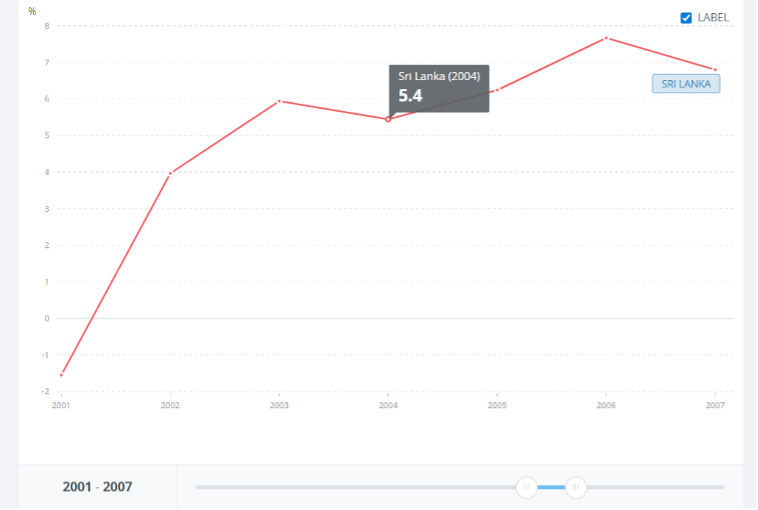
That growth did not mean the tsunami benefited the economy. It meant reconstruction boosted measured output temporarily. Many affected households remained poorer, livelihoods recovered unevenly, and regional inequalities persisted even as national statistics improved. This highlights a critical lesson: growth after a disaster reflects economic activity, not wellbeing.
Similar dynamics are unfolding after Cyclone Ditwah, which affected more than two million people across several districts. Flooding, landslides, and damage to roads, bridges, irrigation systems, housing, and public infrastructure undermined agriculture—particularly in rural and plantation areas where livelihoods rely on climate-sensitive land. Physical damages are estimated in the billions of US dollars, putting pressure on public finances and household incomes.
While the immediate impact of Cyclone Ditwah is negative, discussions are already centring on reconstruction-driven growth ahead. Infrastructure, housing, and public facilities need substantial investment. Government capital expenditure is expected to rise, and external financing is likely to support the rebuilding effort. These factors may lift GDP growth in the short run.
However, lessons from the tsunami caution against an overly optimistic interpretation. Reconstruction spending raises GDP, but it does not erase the loss of assets, income, and security experienced by affected communities. If recovery is financed mainly through borrowing, future debt servicing reduces fiscal space for education, health, and social protection. Rising construction costs and inflation further erode real incomes, especially for poorer households.
Recovery can also deepen inequality if coordination is weak. Regions that attract investment and donor attention recover faster, while remote, rural areas fall behind. Without inclusive policy design, reconstruction can benefit contractors and urban centres more than the most vulnerable communities.
The key lesson from both the tsunami and Cyclone Ditwah is that disasters alone do not determine economic outcomes—policy choices do. Countries that invest in resilient infrastructure, protect human capital, coordinate aid, and prioritise inclusive recovery can emerge stronger. Those focused narrowly on headline growth may mistake rebuilding for development.
Natural disasters undeniably cause immense economic and human loss. They weaken economies in the short term and impose heavy burdens on households and governments. Yet they do not always trigger long-term collapse. Reconstruction can lift GDP, sometimes quickly, creating the appearance of economic strength. But growth after a disaster is not proof of recovery.
The real measure of success is whether people regain secure livelihoods, whether inequality is reduced rather than widened, and whether the country becomes better prepared for future shocks. Disasters destroy. Growth may follow. But sustainable development depends on how wisely recovery is managed.
We’d love to feature fresh perspectives from alumni and students. Share your experience or insight and we’ll get back to you soon.
Send a MessageWork with us to guide students, conduct programs, and strengthen our community.
Get Involved Today